
23
septAmplification Ratio: Super Air Knives

Super Air Knife
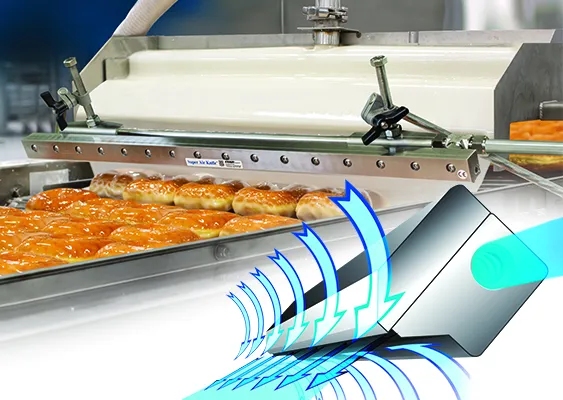
Earlier, I wrote a blog about how entrainment works with EXAIR products by using two phenomena, Coanda Profile and the Venturi Effect. You can find it here, “Entrainment: how it works and why EXAIR products use it.” In this blog, I will cover the Super Air Knife specifically and how it uses the Venturi Effect to entrain the surrounding air.
This Venturi Effect is named after Giovanni Venturi, who discovered that by increasing the velocity through an orifice, the surrounding fluid will move with it, generating a lower pressure. The higher the velocity, the lower the pressure. When you have a low pressure, the surrounding air will fill that void and move into the airstream. The amount of ambient air that gets “pulled” into the airstream is the entrainment, and this amount as compared to the inlet flow is the Amplification Ratio.

So, what does this mean? The definition of a ratio is the relationship between two amounts showing the number of times one value is contained within the other. For the Super Air Knife, it is a value that shows the amount of ambient air that is drawn in along with the primary, compressed air flow. With an amplification ratio of 40:1, that means that there are 40 parts of ambient air for every 1 part of compressed air, which helps make them the most efficient compressed air operated Air Knives available on the market. By adding mass, the Super Air Knife will give a hard-hitting force to do more “work”.
Most people think that compressed air is free, but it is most certainly not. Because of the amount of electricity required to produce compressed air, it is considered to be a fourth utility for manufacturing plants. To save on utility costs, it is important to use compressed air as efficiently as possible. So, the higher the amplification ratio, the more efficient the compressed air product. Manufacturing plants that use open fittings, copper tubes, and drilled pipes for blowing are not efficient. These types of products generally have a very low amplification ratio, somewhere between 2:1 to 5:1. When EXAIR began manufacturing in 1983, we knew that there was a better way of saving compressed air by increasing the amplification ratios of our various air moving products.
I like to explain things in everyday terms. For this analogy, we can use the amplification ratio as represented by gas mileage. Like your car, you want to get the most distance from a gallon of gas. With your compressed air system, you want to get the most utilization for the compressed air being expended. With an EXAIR Super Air Knife, it has a 40:1 amplification ratio; or, in other words, you can get 40 MPG. But, if you use drilled pipes, copper tubes, etc. for blowing, then you are only getting 2 to 5 MPG, so to say. If you want to get the most “mileage” for the money you spend on creating compressed air, you want to check the “fuel efficiency” of your blow-off components.
EXAIR manufactures many blow-off items with high amplification ratios to save compressed air. EXAIR can help “tune up” your blow-off systems to make them efficient and safe by contacting an Application Engineer. We will be happy to help you.